
For Sunday Visit, Botanical Colors sits down with Sydni Gause, the natural dyer and fiber artist behind Sydni Gause Silks, to talk about her Eco-Printed Image workshop and the plant stories held inside silk. From her studio in Panama City, Florida, Sydni has developed a pictorial eco printing method that blurs the line between printmaking, painting, and collage, inviting participants to see plant material as more than a single leaf or flower.

You developed something you call “The Eco-Printed Image,” a pictorial approach to eco printing. How did this way of working with plants and silk emerge for you over time?
First of all, thank you Botanical Colors for having me, it’s an absolute honor to be here and I’m so excited to talk about my dye practice in an interview format.
When I think back on my eco-printing journey, I’m reminded of the first bundle dyeing class I took while living in upstate New York. In this fully remote workshop, I was able to use the big players in the natural dye field for the first time—madder root, logwood, cochineal, you name it. I was completely floored by the results and began to experiment with different bundling techniques, fresh vs. dried dye stuff, and varying cooking methods. At the time, I didn’t have access to fresh plants, so I reached out to florists and farmers in the area to find what I needed. This also helped me explore what worked and what didn’t through a process of trial and error. I made many mistakes in the beginning, but if it weren’t for those experiences, my practice would not be where it is today.
When my husband and I moved to Florida in 2020, I was finally able to start a garden and planted every dye seed I could think of. From there, my eco-printing really started to take off. I ran various tests using plants in my area, explored every type of hibiscus bloom I could get my hands on, and planted exotic dye plants/trees in my yard. Once I had every plant I could think of, I began to layer prints and explore different arrangements. I would start with a base layer of foliage and steam it individually, and then do another layer with giant hibiscus blooms or other botanicals. The prints started to feel like paintings to me; I was fixated on making botanical designs that felt beautiful and like a symmetrical wonderland.
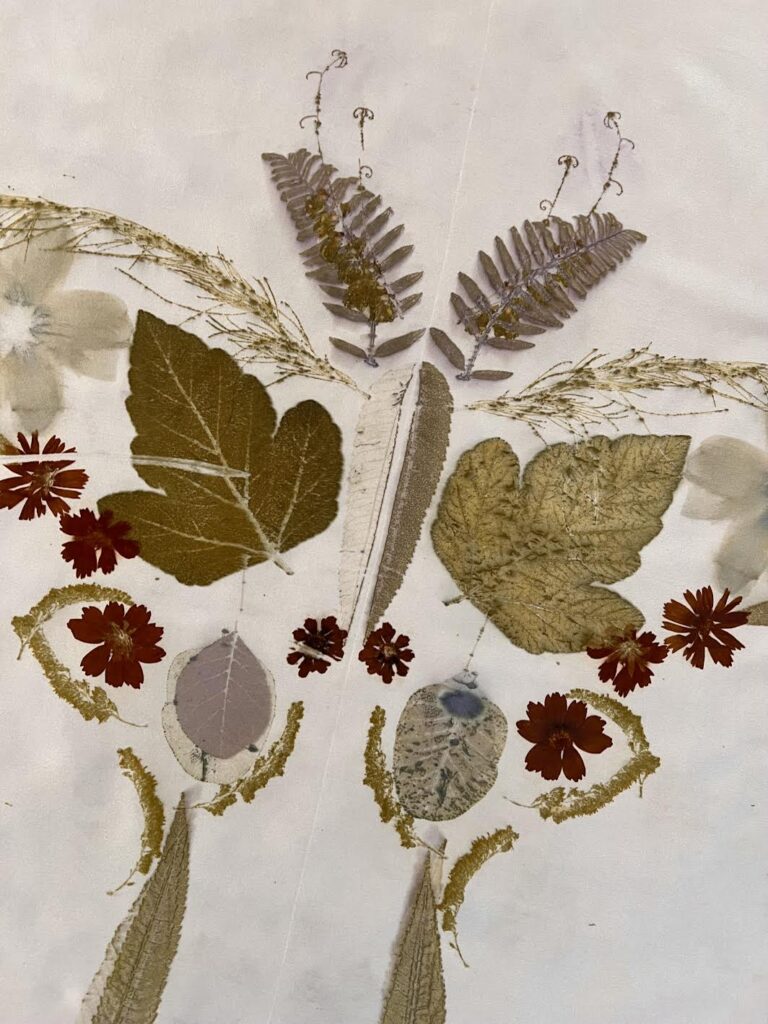
It wasn’t until 2024 that I became quite bored of my eco-prints. I had exhausted all layout options, color schemes, and dye methods. I had eco-printed with almost every dye plant I knew of and wanted to find a way to turn the whole process on its head. The question that came to mind was, “What about my current prints is exciting to me?” I thought back to small moments in larger designs, how I would find funny little details, like a stem reminiscent of deer antlers or a collection of petals that resembled the eyes of an owl— and that led me to my first experiment: mirror-printing a deer skull. I theorized how to print something like that, quickly made a stencil out of paper, steamed it, and to my surprise, it worked!
You describe your process as expanding eco printing into drawing, painting, and collage. What does that look like on the table in front of you when you’re in the middle of making?
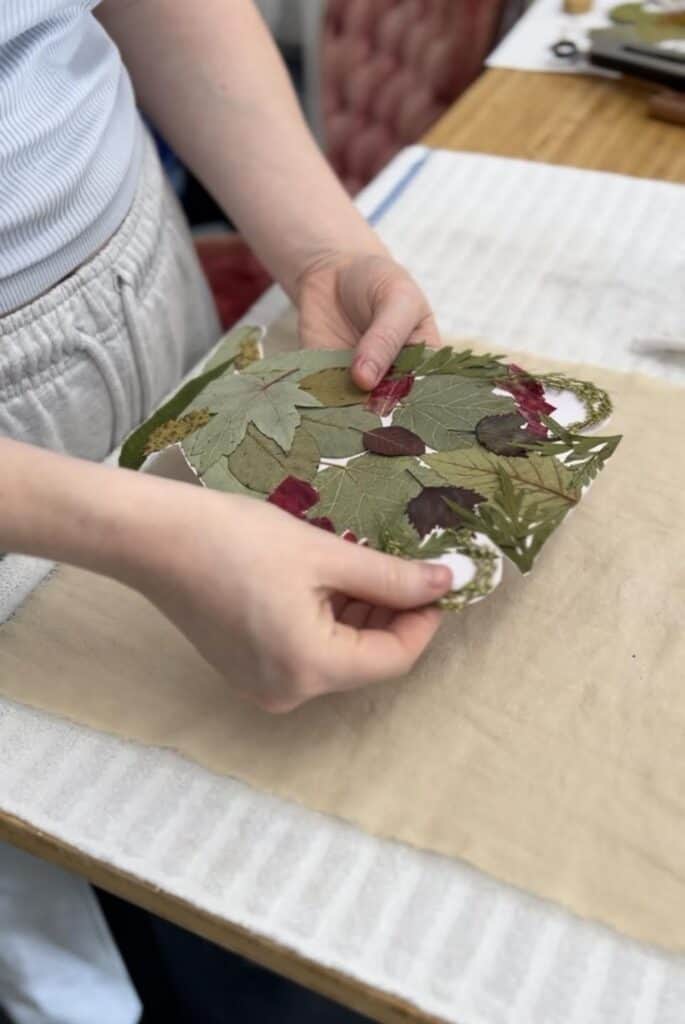
My workspace is usually filled with boxes of pressed flowers, stems, and curly vines. I have a cutting mat in front of me, and I work directly on that surface with my florals and an X-Acto knife. To one side, you’ll usually find Elmer’s glue and a paintbrush, and to the other, a stack of computer paper and pencils.
To paint a picture, I’ll talk about my Deer Skull eco-print on silk. I started by cutting dried plant material and gluing it onto paper, then drawing extensions in pencil, then adding another pressed flower to match the design. The physical language of collage and drawing really began to unfold once the ideas started flowing. It feels a bit like working on a puzzle, but instead of having a reference image, I’m interpreting which shapes, textures, and colors will work in tandem. I’ve also described it as a game of Tetris, which feels like an honest metaphor for the process. It’s exciting and presents a new set of challenges each time.
Can you share a bit about your path from sculpture and dimensional studies into natural dyes and silk, and how that shift changed the way you think about image-making?
This is a great question and I appreciate you making the connection for me to discuss it. When I was working on my MFA thesis exhibition I was dyeing an entire antique quilt a deep charcoal color. I used a synthetic dye I was familiar with at the time and had to make adjustments in the coming weeks to achieve the right shade. During this time I was researching different dye additives and landed on the vast world of natural dyes. I was almost mad that I hadn’t found them sooner because the poetry of dyeing a quilt with plants was filled with a history I couldn’t conceptually achieve with a synthetic dye. I began to think of dyes differently, something that had a scent, that shifted from a live plant to a living color, and that could infuse an object with a sense of place.
The field of natural dyes was curious to me and I immediately felt a kinship to it. I ultimately had to finish my show knowing full well that I had to wait to tackle natural dyes at a later date. Fast forward to today and it’s been eight years that I’ve had a relationship with natural dyes. I would say that my dye garden, dyed works, and artist practice all coalesce into one another. I’ve learned from some amazing dyers along the way, made plenty of “mistakes” and I couldn’t be happier to be a part of this colorful community.
Eco printing often starts with the simple print of a leaf or flower, but your work seems to ask for something more. What questions are you asking when you compose an eco-printed image?
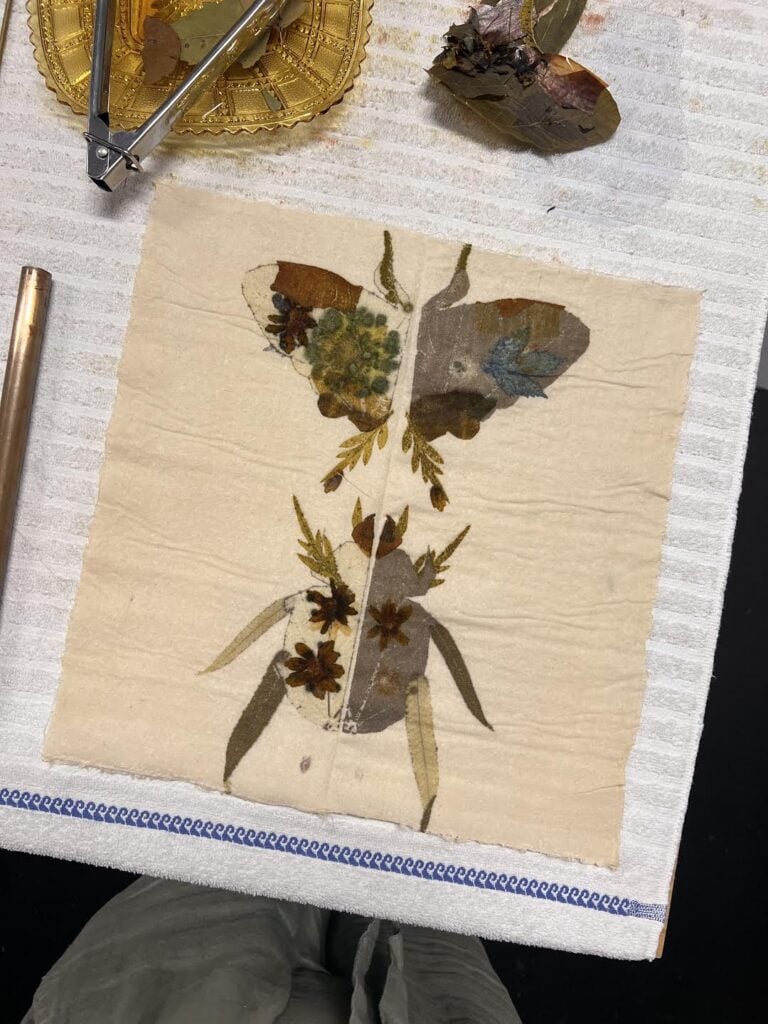
If we look at the prints I’ve composed of animals or insect silhouettes, they feel like an homage to the natural world. Using plants to recreate these forms becomes a kind of nod to the symbiotic relationship between flora and fauna.
When I shift to my eco-printed quilt squares, a different set of questions begins to emerge. What does it mean to print a quilt instead of sew one? And what does it mean to construct that quilt from flora? I don’t know that I’ve fully answered those questions myself, but I often think of my great-grandmother, the matriarch who taught our family about fiber, and imagine she would recognize something familiar in this merging of her two worlds: gardening and quilting.
I also think about how the history of quilting, and the meaning carried within certain quilt patterns, might deepen when they’re printed with plant matter. The materials themselves hold time, what was growing, in what season, under what conditions. In that way, the work begins to function almost like a record, where each print catalogs a moment, a place, and a cycle.
Are there particular plants, leaves, or landscapes that you return to again and again in your work with silk, either for their color or the stories they carry?
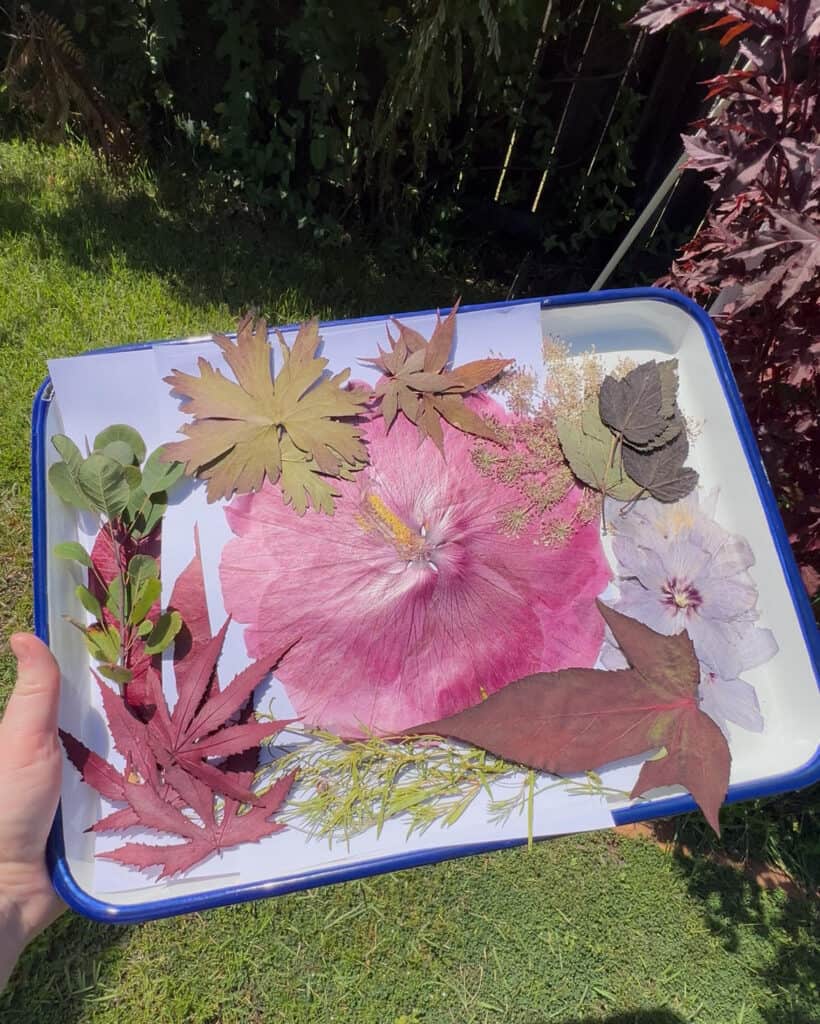
I would say I’m particularly interested in hardy hibiscus. Their dinner-plate-sized blooms are beautiful, and not only are they a showstopper in the garden, but they also make stunning prints on silk. I’m also drawn to plants that aren’t typical printers—in fact, I love experimenting with new and different flora to see how, and if, they print. Collecting and researching new plants has also become a bigger part of my practice these days. It allows for playful experimentation in the studio and keeps me connected to the plants around me. I find a lot of value and pride in that.
Silk can be incredibly responsive to plant-based color. What keeps you devoted to silk as your primary ground, and how does it influence the way your images come to life?
Silk became my fiber of choice because of its undeniable luster that’s simply unmatched. The sheen and softness speaks for itself and really captures the details in each plant. As I write this I’m thinking about the veins in hibiscus petals, silk captures all of it, even the stigma and anther. It’s an amazing fiber for eco-printing.
In your workshop with Botanical Colors, you’re teaching both the Stencil Mirror Printed Image and the Single Plane Paper Image. How do these two approaches differ in feeling for you, and what do participants tend to love about each?
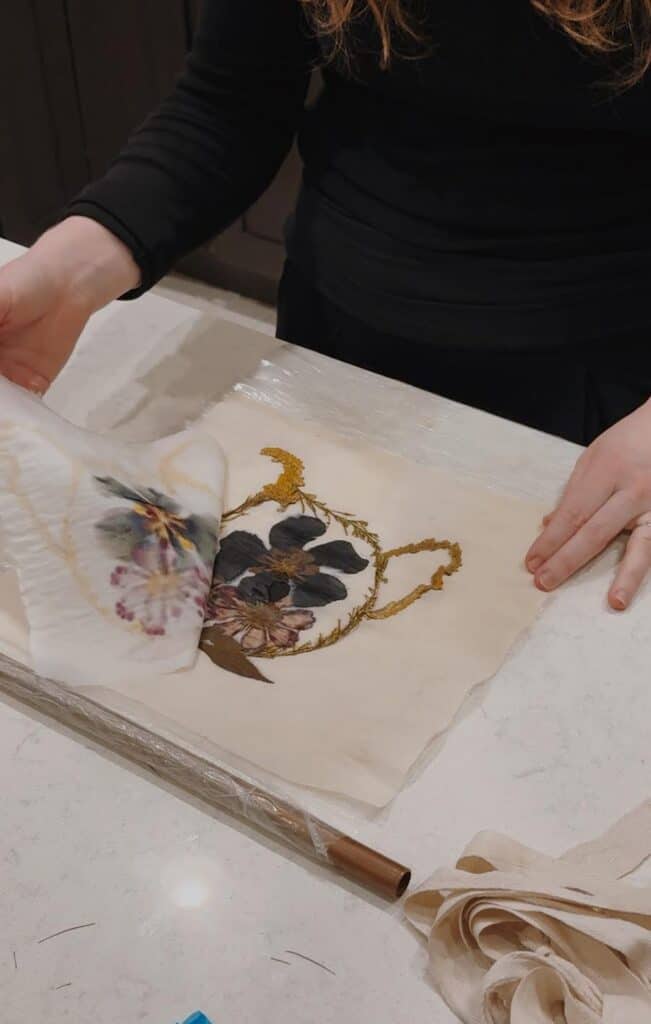
The biggest distinction between the Stencil Mirror Printed Image and the Single Plane Paper Image is that you can rely on one to finish the image for you, almost perfectly since it is a mirror image of itself. While the Single Plane Paper Image leaves a bit more room for play, and freedom. Parallel to this, it’s a more daunting technique because the print is relying on a single plane as opposed to a mirror print. If you like a challenge, you’ll find the single plane paper image to be exactly that. In a great way of course.
You’ve said that plant material can produce more than a standalone print. Can you share an example of a piece where the plants surprised you or took the image somewhere unexpected?
I will share two examples. One plant that surprised me was coral vine with its whimsy tendrils that print so clearly. I knew I could use this plant as an antenna for my Luna Moth print. I paired it with a young leaf from my sumac tree and together they created a perfect feathery print. Another motif that excites me was using a cosmos or coreopsis bloom as an eye socket, as in the case of the deer skull. I love pushing the boundaries of each dye material. Obviously a flower is beautiful on its own, but what does it mean to use it in the absence of a space, as a shadow rather than its recognizable form? When that moment happened I knew I had struck something exciting.
You’ve taught in academic settings and now teach workshops throughout North Florida and beyond. What feels most meaningful about gathering people around the dye pot and the printing table?
The most meaningful thing for me when teaching this process is encouraging others to care about our local and global environments. While this craft is tactile and fruitful, it also comes with responsibility. I always talk about ethical foraging practices and how we can give back to the land that shares with us. Equally important is discussing the histories of these processes, where they were practiced before us and who practiced them. I think it’s not only important to honor the origins of natural dyes, but also to recognize that as we practice them, we remain in conversation with what and who came before us.
When participants leave The Eco-Printed Image workshop, what do you hope stays with them—either in their hands or in their way of seeing the natural world?
It’s my hope that participants leave the workshop chomping at the bit to create an eco-printed image of their own. I want to see big ideas translated onto cloth- whether that’s testing the limits of the technique, pushing scale, or creating something more poetic and meaningful. I want to inspire them to get their hands dirty and jump right in. I’m a big believer in experiential learning, so I hope the energy they leave with is a sense of play, a willingness to explore the boundaries of this art form and push past them, even without knowing the outcome. It’s in that space of discomfort that the magic happens.
Your work has been featured in publications that bridge art, craft, and place. How does your local environment in Florida shape the palette and imagery that show up in your eco-printed silks?
Being in Florida really shapes both the palette and the imagery in my work. Because I’m in Zone 9, I’m able to grow and harvest dye plants year-round, so I’m constantly working with what’s growing around me. In the warmer months especially, I’m growing more tropical plants like eucalyptus, hibiscus, and coral vine. They need that intense sun and heat, which we have plenty of, and they produce some of the most beautiful prints. The colors, the shapes of the leaves, the textures, they’re all distinct and have naturally become recurring motifs in my work. I’m also really inspired by the life in my yard- the animals, birds, and pollinators that move through the small ecosystem we’ve made here inform the subject matter I pull from. Consequently, a lot of what shows up in my work is directly tied to what’s growing and living around me.
For someone arriving at eco printing for the first time, what mindset or small practice do you recommend they bring into the studio with them?
The most important thing I would say to someone new to eco-printing is that you’re going to make mistakes, you’re going to fail, but that is what will make you a strong eco-printer. You almost have to fail countless times so that you understand what works and what doesn’t. I have to give a shout-out to all my failures because I wouldn’t have developed the Eco-Printed Image without them. I am of the belief that you need to fail in order to succeed, problem-solving is a necessary, annoying, and time consuming part of this craft, but it’s probably the most important.
Finally, what’s one small way you think people can deepen their relationship with the plants around them, whether or not they ever take an eco printing workshop?
One thing I always ask when discussing ethical foraging is this: if you’re taking something from a plant (leaves, blooms, tendrils, etc) how can you give something back to that same ecosystem? It doesn’t have to be a monumental gesture, it can start small. The point is to begin thinking about how you might care for the plants that are sharing parts of themselves with you.
Some responses I’ve heard, which are site-dependent, include watering, adding compost or organic fertilizer, or simply tending to the space- cleaning up debris, mulching, or practicing mindful pruning. Even scattering non-invasive seeds to boost biodiversity would be a kind thing to do. At its core, it’s about reciprocity. An agreement to tend and collaborate with the land we have the privilege of living on.

