Mordant Monday: Middle Mordant Magic

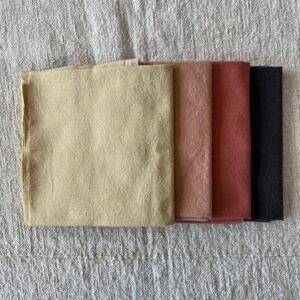
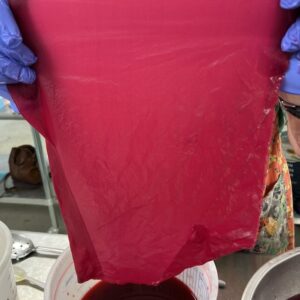
In this week’s Mordant Monday, we discuss Middle Mordant. Middle Mordant is a technique that I learned about from The Art and Science of Natural Dyes. It’s considered to be a Japanese technique and is a simple way to create rich color on silk. Middle mordant uses room temperature dye baths and you can repeat the process until the fabric is the color you want. The purpose of middle mordant is to deepen the depth of shade and most of the examples I’ve seen use silk fabric and alum mordant. There are somewhat similar techniques that old dye books discuss, … Read more
Mordant Monday: Sneak peek of a new product

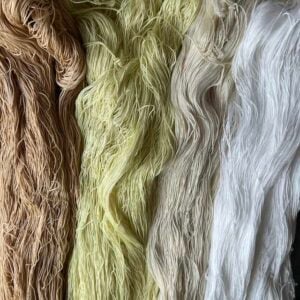
Mordanted Sashiko Thread with Different Tannin Options! Now you have the convenience of using tannins and a pre-mordanted thread to create your own color palettes and who doesn’t love that? Pictured from Left to Right: Cutch and Alum mordant, Sumac and Alum mordant, Gallo-Tannin and Alum mordant, and PFD, unmordanted Sashiko Threads We’ve been busy adding to our very popular mordanted product line, and will be offering mordanted Sashiko threads using three different mordant variables. The light brown color is Cutch, a light brown tannin, the yellow is Sumac, a yellow-based tannin, the light cream is Gallo-Tannin, a “clear” tannin, … Read more

Mordant Monday: Q&A

Mordant Monday this week is all about questions:  some are mordanting questions and others are the victims of spellcheck.   I changed my mind How do I change a mordant after the fact?  I have some wool and cotton fabrics with alum on them but I really want to have them mordanted with iron instead. Can I remove the alum and start with an iron base? Answer:  Alum mordants are very durable and long-lasting bonds, and while there are a few substances that can weaken or damage them, using them would probably also damage the fabric and we don’t recommend this … Read more

Organic Soybeans

Soymilk as a Printing Binder for Mordant Monday

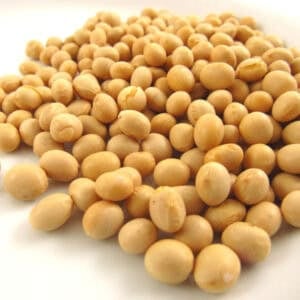
Soymilk as a printing binder In today’s Mordant Monday (excuse the awful pun – I found it online), we check out how to use soy as a binder for natural dyes and pigments. Before the widespread use of acrylic paints and mediums, artists had ingredients from the natural world to use for painting and printing on paper and canvas. They used a wide range of natural binders including tree sap, milk, egg, oils, minerals and other substances that helped pigments stay attached to substrates. In Japan, soybeans are the most common binder for textile work, and it serves as a … Read more

Mordant Monday: Gallo Tannin Gradation with Fustic and Madder

Gallo Tannin Gradation with Fustic and Madder This week’s Mordant Monday focuses on Gallo Tannin, also known as Oak Gall tannin, or Oak Galls. We used the extract made from Oak Galls in our gradation, but a similar result comes from oak galls that have been crushed or pulverized. Gallo Tannin is one of the ancient tannins with many uses, including making black ink, leather tanning, and in traditional Asian medicine. It is the most commonly used tannin when mordanting with tannin + alum, as the color it imparts is very light, and it doesn’t show a strong undertone, like … Read more

Mordant Monday: R U Mordant Curious?

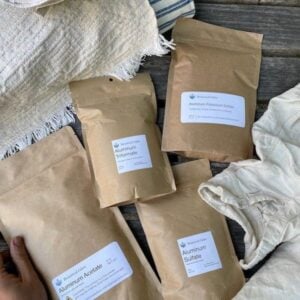
For Mordant Monday, we answer your Mordant Questions and dive into everyone’s favorite topic: MORDANTS. Are you Mordant Curious? I received a great question about the mordants we carry. Like, you have so many. What is the difference? Does it really matter? Having a variety of mordant choices allows you as an artist to consider your materials before you start creating. For example: if you are dyeing a cellulose fabric, you can use aluminum acetate, or you can use a tannin pre-mordant and then apply aluminum sulfate as the mordant. They will give you different results. We’ve created a table … Read more

Mordant Monday: Spotlight on Sumac

Spotlight on Sumac Taking a little time to work more closely with tannins has been incredibly interesting! This week’s tannin exploration focuses on Sumac. Sumac is from the Rhus genus and its scientific name is Rhus coriaria. It’s native to southern Europe and western Asia where it is commonly known as Tanner’s Sumac or Sicilian Sumac. We are fortunate to have number of North American native sumac including Rhus glaubra, sometimes called Smooth Sumac, and Rhus typhina or Staghorn Sumac, known for its dramatic bright red berry clusters. The staghorn berries were used by indigenous people as a tea, and … Read more

You Asked, Kathy Answered: What IS Calcium Carbonate?

YOU ASKED: May I ask what you mean by calcium carbonate? I read in your description of “calcium carbonate” you compare it to chalk. This confuses me because chalk is caso4•(H2O) while calcium carbonate is caco3. KATHY ANSWERED:  What we call “chalk” in the US is Calcium Carbonate – CaC03, a powdery white material.  The formula that you reference is Calcium Sulfate and it may also be called “chalk” but in the US, we commonly refer to it as “gypsum”. Calcium carbonate is used to mark soccer fields, as a dietary calcium supplement, an ingredient in antacids, and building materials! … Read more

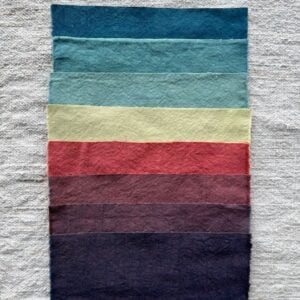
Seven swatches of blue fabric from very pale on the left to dark navy blue on the right

A Deep Dive into the 1-2-3 Indigo Vat

Indigo gradation from Aboubakar Fofana’s workshop on indigo.  The vat is a 7gpl fructose vat. Diving into indigo blue We have been working with the 1-2-3 indigo vat for nearly 10 years and over time made some adjustments to the original recipe from Michel Garcia. Here we share a recent experiment where we set up 4 different types of 1-2-3 vats and present the results. New instructions are linked below for each vat type with hints for a successful indigo vat!  You can also search our blog posts for information on indigo vats and answers to your many questions. Our … Read more

Covid-19 update from Botanical Colors

Covid-19 update from Botanical Colors Greetings from Seattle – ’nuff said about that. We are heartbroken that so many of our dear creative friends are feeling the fear and uncertainty of the outbreak. It is a crazy time, and not knowing what’s going to happen is unnerving. We are doing okay, and taking an abundance of health precautions. The weather is sunnier, daffodils are in bloom and the Winter Daphne (Daphnia odora) is delighting us with her amazing fragrance. Those simple things are lifting our spirits during these difficult times. The dog is delighted that we are around a lot … Read more