

Here’s a round up of mordant questions from the community!
Do I need to rinse mordants before dyeing?
We rinse aluminum potassium sulfate mordanted fibers lightly before proceeding to the dye pot.
We rinse aluminum acetate mordanted fibers lightly after we’ve completed the calcium carbonate dunging step.
We rinse aluminum sulfate and tannin mordanted fibers lightly after the aluminum sulfate step.
We rinse aluminum triformate mordanted fibers after the mordant step.
We rinse iron mordanted fibers well after the iron mordanting step.
How do I increase the amount of mordant on something that’s already been previously mordanted?
We’ve had good success with mordanting previously mordanted goods, either dyed or undyed. To do so, simply weigh the dry fibers, and calculate the amount of additional mordant you’d like to add. Follow the mordanting instructions and remordant the goods. Rinse and proceed to the dye step.
Do I need to dung all cellulose fibers regardless of the mordant I use?
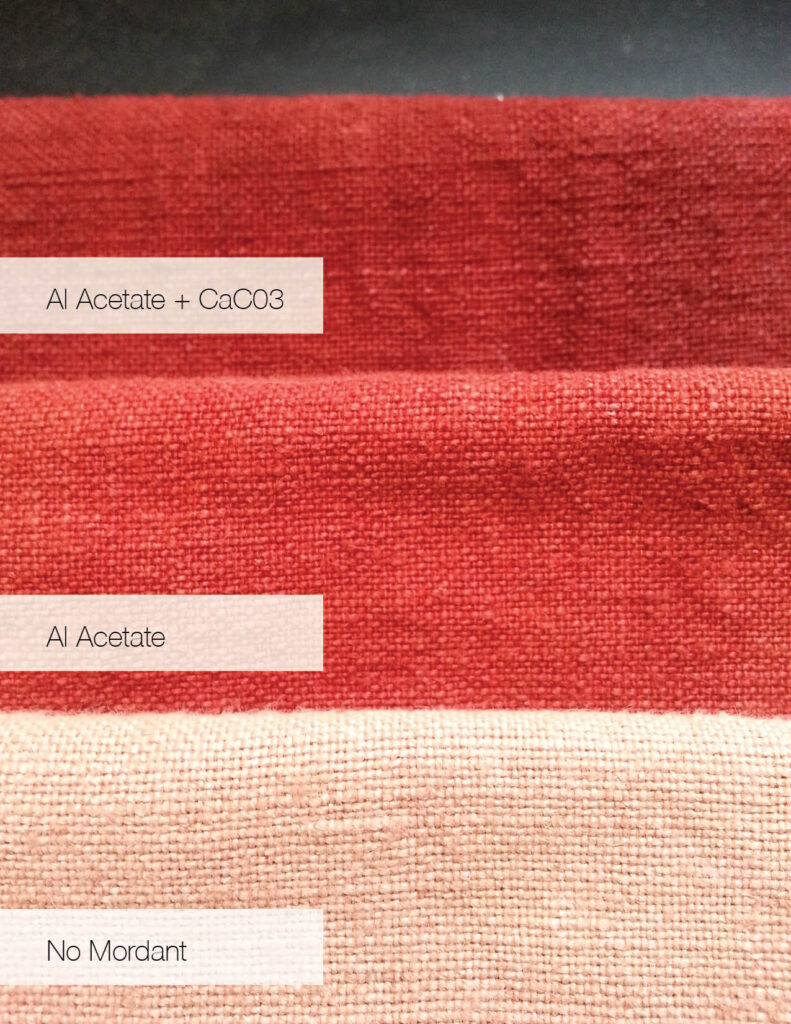
We dung (use a post-mordant calcium carbonate bath) only when mordanting with aluminum acetate. Aluminum acetate works better if it is fixed with a calcium carbonate post-bath. Below is an image of heavy cotton fabric that was mordanted and dyed with aluminum acetate with a calcium post-bath and without a calcium post-bath. The difference is dramatic.
My mordant pot is turning black!
I have a 40-quart pure aluminum tamale steamer that I have been using to scour and mordant larger pieces. Now I find the pot is turning black on the inside. I tried to remove the discoloration, but nothing is working.
Aluminum pots are susceptible to discoloration and even pitting if you use an acidic solution or a high alkaline solution like scouring in them. Something like soda ash will eventually start eating the inside of the pot, and acidic liquids like vinegar will also react with bare aluminum. This makes aluminum a little tricky to use in the natural dye studio as many of our dye baths can be somewhat acidic, and scouring is alkaline. We recommend using non-reactive containers for both scouring and mordanting. Stainless steel stock pots are expensive. It is possible to use large enamel lobster pots, or canning kettles, and these are lower cost.
It is also possible to cold mordant many fibers, using room temperature solutions, and for these processes, plastic tubs and buckets often come in handy!
Resources
Check out our Natural Dye Instructions for detailed information on the natural dye process. We also have extensive information about indigo, including how to make and maintain a 1-2-3 indigo vat and a comparison among the different 1-2-3 vats, including fructose, iron and henna vats.
Questions?
Email us at [email protected]. We will do our best to point you to resources or information to answer your natural dye questions.