This week: Painting silk fabrics with liquid dyes

Thank you to Rachel MacHenry and Gitte Hansen of Contemporary Textile Studio Co-operative for the lovely photos! I taught a one day workshop on middle mordant using Japanese dyes in Toronto on Friday, and had a great time with the students. This was the first time we’d tried the technique using only Japanese dyes that we extracted, and we also had a side trip into kakishibu which didn’t require any mordant, but made a beautiful shade. I’ve written about middle mordanting before: Catharine Ellis has a nice recipe and procedure in her book and Studio Notes, and I’ve also seen … Read more
In this week’s Mordant Monday, we discuss Middle Mordant. Middle Mordant is a technique that I learned about from The Art and Science of Natural Dyes. It’s considered to be a Japanese technique and is a simple way to create rich color on silk. Middle mordant uses room temperature dye baths and you can repeat the process until the fabric is the color you want. The purpose of middle mordant is to deepen the depth of shade and most of the examples I’ve seen use silk fabric and alum mordant. There are somewhat similar techniques that old dye books discuss, … Read more

We get mordant questions all the time at Botanical Colors so why not create Mordant Monday??? Got mordanting questions? Email [email protected] YOU ASKED: I was wondering what is the best way to scour or mordant raw silk? I know you have on your site that info for silk but just wanted to ask if that applied the same for raw silk as well. KATHY ANSWERED: Raw silk, also referred to as silk noil, is the carded short waste pieces from silk reeling that are carded and spun before weaving or knitting. The fiber is medium weight, textured, matte and can … Read more

We get mordant questions all the time at Botanical Colors so why not create Mordant Monday??? Got mordanting questions? Email [email protected] YOU ASKED: I have several cashmere sweaters that are the most boring colors ever and I’d love to try over-dyeing. I have Orvis paste to scour with but wanted to check that the 180 degree hold for 30 minutes would also work for cashmere – I see sheep and goats on the website answer about scouring so I am assuming yes, but there is this little question in the back of my head – email to the experts it … Read more

Our last FEEDBACK FRIDAY was with Godelieve Keulen, the founder of Hari Baru Paris. Godelieve’s background is as a fashion designer specializing in knitwear but all of her designs are inspired by natural dyes. We found her through Instagram and fell in love with her beautiful zabutons, Japanese sitting cushions traditionally used for sitting on the floor. Watch the video recording here. From Godelieve: “I became interested in natural dyes during my sabbatical leave of 9 months in Kyoto, Japan. My husband was working at the university there. I immersed my self in the local artisanal crafts which one of … Read more
This week: Print paste thickener
with natural dyes and preparing fibers for pro dyeing results
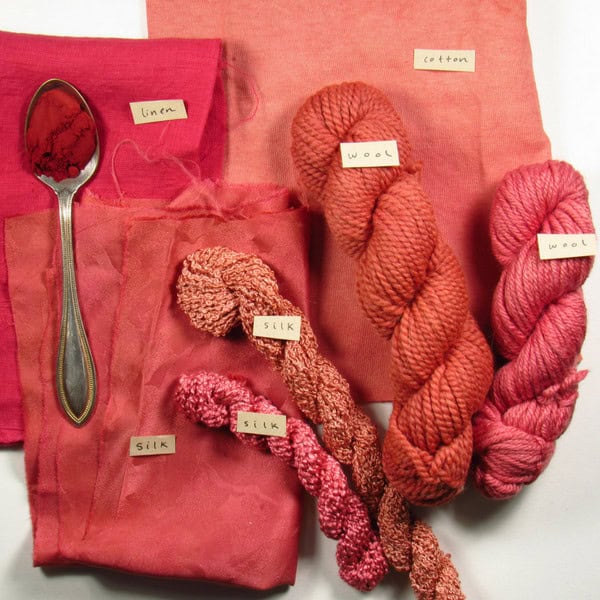
This week: We answer wheat bran questions and other inquiries about natural dyes in this week’s Feedback Friday.

Each week, we are emailed with questions from our natural dye community asking simple and complex questions that we thought might be worth sharing. Here are a handful from this week answered by natural dyer in chief, Kathy Hattori, Founder of Botanical Colors: I am really new to dyeing–is the material to be dyed mordanted first, then dyed? When I developed film/printed photos, you always “fixed” at the end to keep it from continuing to develop. Please help; I’m trying to understand and visualize the process. Many thanks! The procedure that I prefer to use is: Scour or clean the … Read more
Botanical Colors
Seattle, WA
© Botanical colors 2026