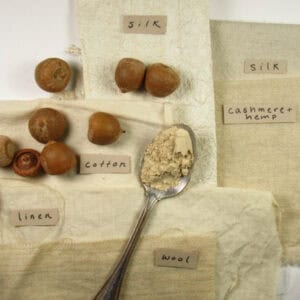
acorns and a spoon of tan powder on pale fabrics

MORDANT MONDAY: Which Plants Need Mordant?

We get mordant questions all the time at Botanical Colors so why not create Mordant Monday??? You Asked: I keep getting mixed answers from people about dyeing with plants from my yard and whether I need to mordant or not when using them. Advice? Kathy Answered! I think some of the confusion arises over what plant we’re talking about. Many plants contain high levels of tannins and these can be used to mordant and dye in one step, rather than using the traditional mordant method with aluminum sulfate or aluminum acetate. Traditional tannin mordants include: Common garden and kitchen tannins … Read more

MORDANT MONDAY: Mixing Mordants

We get mordant questions all the time at Botanical Colors so why not create Mordant Monday??? YOU ASKED: I’m just trying out your new cold mordant aluminum triformate and have mordanted wool, bamboo and cotton After applying tannin to the cellulose I dropped it into the aluminum triformate together with the wool, and the water changed to green. I guess it’s due to the connection between tannin and aluminum? But am I doing something wrong and are the textiles fine for dyeing now? I want to save the mordant bath for further use but now it has a suspicious color. … Read more

Mordant Monday: In the clutches of Cutch Dye

Cutch Dye This week’s Mordant Monday explores another well known and important tannin: Cutch. Cutch is a wood dye from Senegalia catechu (formerly Acacia catechu), an acacia species that grows in South and Southeast Asia. The dye is both a colorant, and a traditional medicine. It is also the by-product from the manufacture of “katha”, which is a crystalline substance that is an ingredient in paan or betel nut leaf, which is an Indian mouth freshener and digestive. We’ve never tried paan, but we love cutch for its versatility and deep colors. It’s a sweet-smelling dye and the color yield … Read more

Mordant Monday: Tannin Rainbow with Chestnut, Fustic, Iron and Indigo

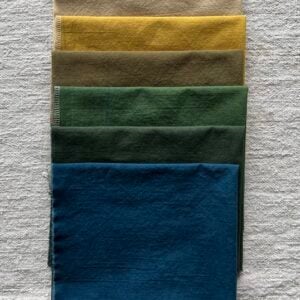
Tannin Rainbow with Chestnut, Fustic, Iron and Indigo This week’s Mordant Monday focuses on Chestnut. We used Chestnut extract in our gradation and absolutely loved the combination of Chestnut, Fustic and Iron with Indigo. This gradation is slightly different than our previous experiments. This time I did not overdye with a warm shade like Madder, to get corals and pinks. I wanted to focus on green and blue. Like previous examples, when a tannin is combined with other colors you can get exciting mixes and beautiful color blends that harmonize and are perfect for patchwork, creating gradations and stitching. If … Read more

Sunday Visit: The Eco-Printed Image with Sydni Gause

For Sunday Visit, Botanical Colors sits down with Sydni Gause, the natural dyer and fiber artist behind Sydni Gause Silks, to talk about her Eco-Printed Image workshop and the plant stories held inside silk. From her studio in Panama City, Florida, Sydni has developed a pictorial eco printing method that blurs the line between printmaking, painting, and collage, inviting participants to see plant material as more than a single leaf or flower. You developed something you call “The Eco-Printed Image,” a pictorial approach to eco printing. How did this way of working with plants and silk emerge for you over … Read more

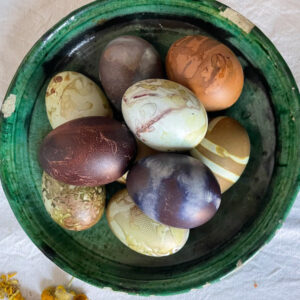
multicolored dyed eggs in a green ceramic bowl

Dye Easter Eggs With Natural Dyes

Everyone from kids to adults love to get their hands messy when they dye Easter eggs with natural dyes. This is a fun tutorial for adults and kiddos (parents help, please) to make a little Easter magic. First things first, let’s talk about health & safety: We always recommend working in a very well ventilated area. Although natural dyes are non-toxic, when using fine powders it’s best to wear a mask, and keep the windows open. Be mindful around little ones and pets as you don’t want anything going in mouths that shouldn’t be there. Also, when beginning to set … Read more

Mordant Monday: LIME GREEN

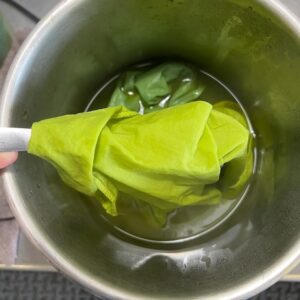
On this Saint Patrick’s Day, learn how to make this punchy lime green! We are pulling this exciting color back from our archives. Wink wink, you might remember it from this summer…Using weld and indigo, you can get awfully close to this punchy acid green. Natural dyes are often thought of as pastel or “soft” colors, but we’re here to help you make a hue that really packs a punch! This is the basic recipe Start with a mordanted cotton bandana, soak it in warm water for 30 minutes to thoroughly wet it out, and dip in a very light … Read more

Mordant Monday: We stand with Minnesota and Maine

Botanical Colors is an immigrant company. I experienced hearing the stories of my mother and father who were stripped of their constitutional rights and incarcerated for three years in US concentration camps during World War II. They were US citizens. They too, were taken away and “detained” because the government didn’t like the way they looked and where they came from. The events occurring in Minnesota and Maine (and not to forget LA, Chicago, and other US cities) are profoundly disturbing to me. Botanical Colors stands in fierce, grieving solidarity with our communities in Minnesota and Maine who are facing escalating … Read more

Mordant Monday: Why so Many Alums?

For today’s Mordant Monday, We are revisiting a great question: All those alums?! Why so many alums? You Asked: Hello, I am wondering if it is possible to use Ammonium Aluminum Sulfate for mordanting wool? I am finding this substance in the spice section ofthe grocery store. I can’t seem to find definitive information about this and I feel confused about all the different “alums” that exist.  We answered: The different alum types are basically the same mineral but they are refined differently for different purposes using a variety of chemicals. They can look different, too. For protein fibers, aluminum … Read more

Mordant Monday: Wool Fibers Feel Weird

It’s winter, and many of us have taken up knitting and crocheting during the cooler weather. While I’m thinking about knitting, my mind wanders to mordanting (of course), and some of the questions we’ve received from curious dyers.   This Mordant Monday, I thought I’d start with some common questions when mordanting changes the hand feel and quality of wool fibers. The natural dye process uses a lot of heat, and a fair amount of handling: stirring, squeezing, rinsing.  It’s easy for wool to react to all of this and become rougher feeling, even felted!  Check out this week’s Mordant … Read more