Mordant Monday: Nerd Week at Sanborn Mills Farm

I’m at the airport after teaching for 5 days at Sanborn Mills Farm in New Hampshire. Sanborn Mills Farm is a working organic farm and craft school specializing in traditional crafts such as blacksmithing, woodworking, basketry, kitchen and textile arts. We saw newborn lambs, massive draft horses and oxen and dormant grain fields just starting their spring activity. Sanborn Mills Farm is one of my favorite places to teach with a dye garden a few steps away and trails and farm animals to visit and observe. The weather was typical unsettled early spring and we encountered high winds, heavy rain, … Read more
Mordant Monday: Creating Color In Tucson

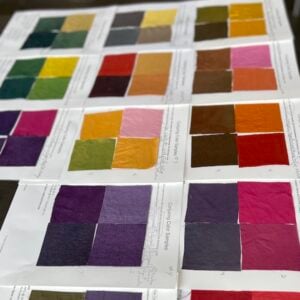
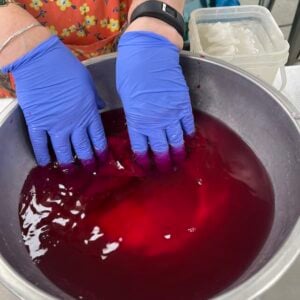
We used raw dyestuffs: cochineal insects, coreopsis flowers, marigolds, extracts and two indigo vats (henna and fructose). I was very impressed how beautiful the colors came out! I was fortunate to teach in Tucson, Arizona last month for the Tucson Handweavers and Spinners Guild. This was my first time in Arizona and it was a wonderful experience.  The dramatic desert landscape really commands your attention and the light just before sunset is luminous. The swatches are from a number of different dye baths and we mixed and matched colors to create 4-color palettes with an indigo dip at the end. … Read more

Mordant Monday: Can I Mordant after Dyeing?

YOU ASKED:  Can I mordant after dyeing? I just returned from India, dyed a number of silk scarves and was told the I can mordant them after they have been dyed. I have been trying to find more details but have only read on your site about post-mordanting something that has already been mordanted?   KATHY ANSWERED:  There’s actually a technique that is practiced in Japan that is referred to as “middle mordanting”. The process is to immerse silk fabric in dye, then transfer it to a mordant bath, and then return it to the dye bath. It definitely deepens the … Read more

MORDANT MONDAY: To Mordant Or Not To Mordant + Disposing Of Mordant Baths

We get mordant questions all the time at Botanical Colors so why not create Mordant Monday??? Got mordanting questions? Email [email protected] What is Mordanting? Mordanting is the most important process of preparing fibers to accept color. Using a mordant helps to ensure the most durable and long-lasting colors. With the exception of indigo (as a vat dye, it does not require a mordant), this is not an optional step. However, there are many different mordants you can use. Deciding which mordant to use comes down to the types of fibers you want to dye and how much time or energy … Read more

Mordant Monday: Tannin Workshop Review

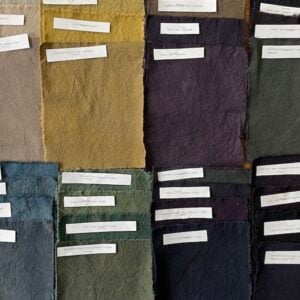
Mordanted fat quarters in iron, marigold, indigo, marigold+indigo, logwood, logwood+ indigo, logwood + marigold and logwood + marigold+ indigo. Both Cara and I taught new online workshops about tannins and natural dyes this month. Cara introduced Tannin Grayscale, a fascinating look into using iron and tannin to create a rich range of deep and moody neutrals. I had envisioned that this would be a workshop on gray, gray and more gray, but the surprise was that her techniques create some beautifully saturated shades. My workshop was Tannin Rainbow, where I concentrated on combining different tannin mordanted fabrics with natural dye … Read more

Mordant Monday: How do I dye Green?

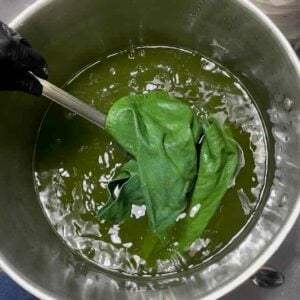
We receive a lot of questions about our favorite subject of natural dyes and two questions that I thought might be interesting to share are: – How do I dye jute or burlap? – How do I dye green? We detail information from each question and there are lots of links with how-to and recipes for further exploration! DYEING WITH JUTE Jute is a fiber from the Corchorus plant, and the largest global jute-producing region is West Bengal, India, and Bangladesh. Jute is an annual plant, rapid-growing, and produces long fibers in its stalk, similar to linen and hemp. The … Read more

Mordant Monday: A Rainbow Compilation!

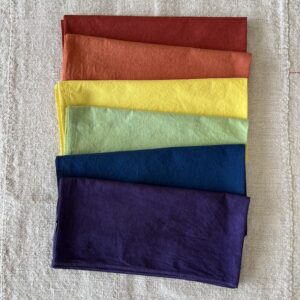
We wanted to compile all of our rainbow tutorials so you could have access to them all in the same place. We love creating them for you, and seeing the beautiful creations you make with your tutorials. Tannins provide a rich base for creating a rainbow of color. Please tag us on social media so we can see what you make! Try making the rainbow yourself!

Mordant Monday: Sneak Peek on Hand Painting Yarns and Fiber

For this MM (posting on Tuesday because what is time anyway?) we wanted to get you excited about some new mordanted yarn offerings we are launching in the upcoming weeks for the holiday season. In case you didn’t know, Kathy is an incredible yarn dyer and we wanted to share with you some of her fun tips on creating beautiful rainbow creations on yarn and fibers. With our mordanted yarn bases, you will be able to create your own color palettes and personalize yarns for your own projects! Getting started We will offer detailed instructions for basic yarn painting once … Read more

Mordant Monday: Dyes of The Américas

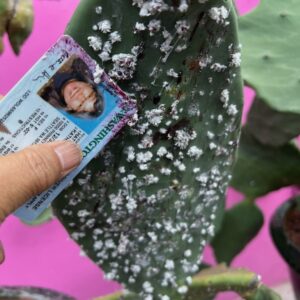
One of the first dyes that I ever encountered was cochineal, and although I was surprised that it came from an insect, I was also in love with its beautiful color.  Cochineal was the most important natural dye to originate from Oaxacan indigenous culture that still has great value and a global impact today. When Spanish colonizers realized the value of this dye, they created plantations and exploited indigenous labor to process up to 300,000 pounds of cochineal for export per year. It was one of the most precious colors and brought great wealth to the Spanish crown. Being in … Read more

Sunday Visit: Meet our newest team member Zach!

For Sunday Visit, Botanical Colors sits down for an interview with a luminary in the natural dye, textile and art world. This week we’re really excited to introduce our newest team member Zach. Zach works with us in our dye house and is an experienced and talented dyer himself. Read a little bit about him and his inspirations below. Tell us a little bit about yourself. How is it working with Botanical Colors? I am Washington raised and a recent graduate with a focus in technical apparel design. I am deeply appreciative of the natural world and am constantly drawing … Read more