For Sunday Visit, Botanical Colors sits down with Julie Beeler, the artist and researcher behind Mushroom Color Atlas, to talk about her fall workshop and the surprising, luminous world of fungi-based color. From her base in the Pacific Northwest, Julie has spent years building a living reference of mushroom dyes — cataloging the reds, golds, rusts, greens, blues, and grays that emerge when fiber meets fungus — inviting dyers to look past the forest floor and into an entirely different color story.
For those just discovering your work, how would you describe what the Mushroom Color Atlas is — and what first drew you into the intersection of fungi and natural dye?
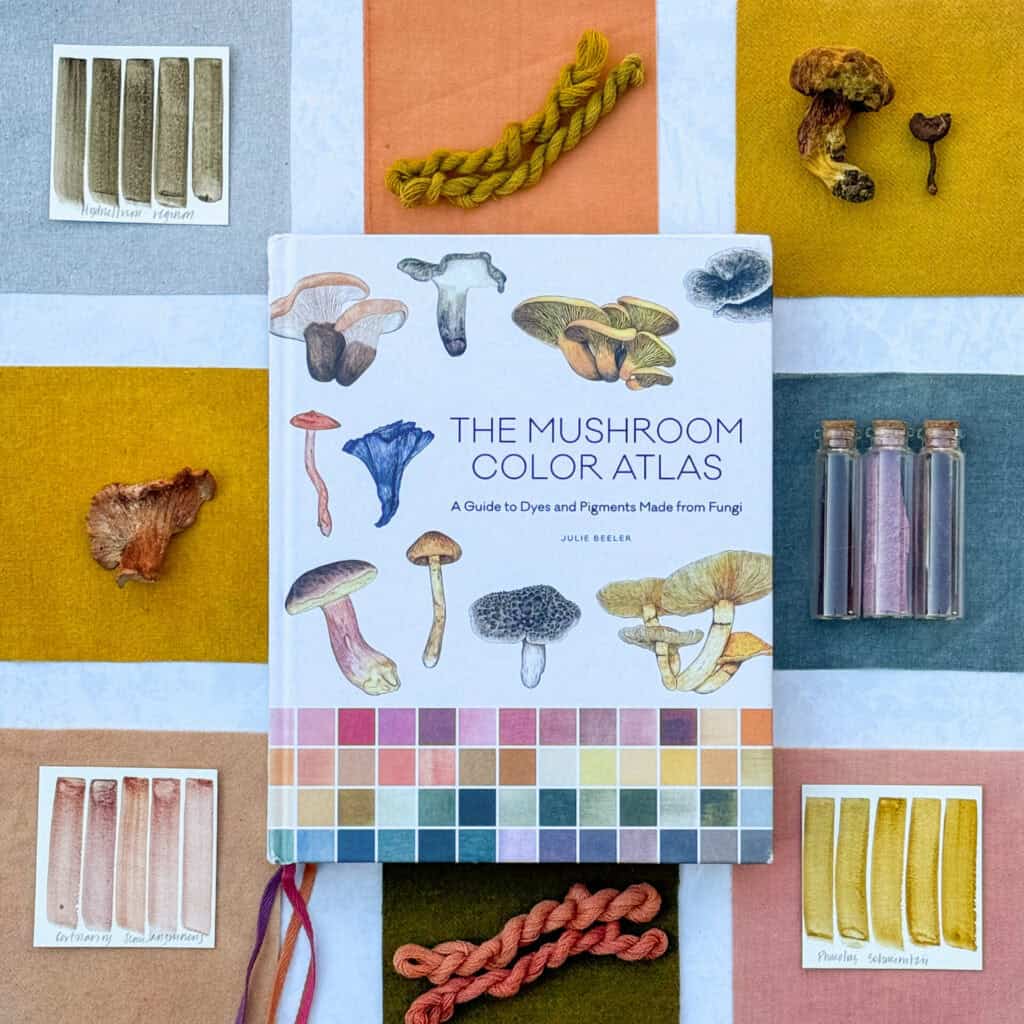
The Mushroom Color Atlas is a living archive of the colors hidden within fungi. I created it to unveil and share what often goes unseen, a resplendent chromatic universe that lives quietly beneath our feet. Mushrooms can appear small and subtle in the landscape, yet when worked with, they release luminous, complex pigments.
What first drew me to them was a moment of serendipity. I was finally able to dedicate time to learning more about the mycological world, as well as pivoting my textile practice toward creating my own natural colors, patterns, and textures. Out of curiosity, I searched Google to learn, “Do mushrooms make color?” and discovered a book by Miriam Rice and Dorothy Beebee. That discovery opened a door. It felt like uncovering a color story rooted in the place where I live.
I love that you describe yourself as an alchemist, what is it about your practice that feels alchemical? Can you dive into this for us further?
It feels like alchemy because transformation sits at the core of the work. I begin with materials that are alive, or recently alive—mushrooms, plants, bark, roots, berries—and through time and process, they become something entirely new. Color emerges through interaction: layered, absorbed, resisted, and transformed until it settles into a surface as both image and imprint. It is the space between intention and emergence where the work becomes most alive for me.
Walk us through what happens from the moment you forage or source a mushroom to the moment you have a finished dyed skein. What surprises people most about that process?
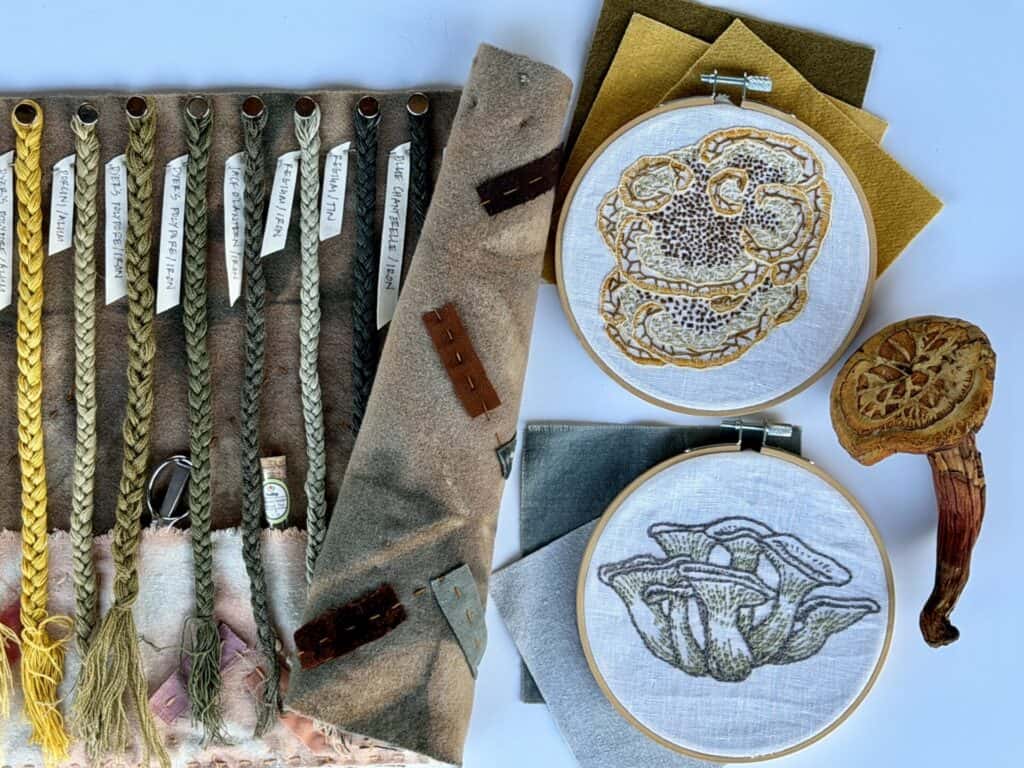
It begins in the forest with observation and attention. I am looking at habitat, season, and relationships between organisms. Once harvested, mushrooms are broken into smaller pieces and either dehydrated, frozen, or used fresh in the dye pot. They are slowly simmered to release pigment, while fiber is prepared separately so it can properly receive the color.
From there, it becomes a dialogue between material and process. Time, temperature, and subtle shifts in chemistry (pH) all play a role. What surprises people most is how much color can come from something that appears muted or small in the landscape, and how a single species of mushroom can yield a wide range of tones depending on fiber, preparation, and conditions in the dye bath. The process asks you to release control and pay attention in a different way.
How do you approach color documentation? The Atlas is such a meticulous record — what does that archiving practice mean to you beyond just the science?
Documentation is central to my practice. I have always been drawn to libraries, archives, and museums, and to how knowledge is carried forward through careful record-keeping. I keep detailed notes to understand and, when possible, replicate results, but the work extends beyond that.
For me, archiving is also a visual language. The Mushroom Color Atlas is an archive of something that has not been widely recognized and an invitation into this world of working with fungi for color. It holds both information and experience, while honoring the specificity of place, season, and material that shapes each result.
Are there mushrooms that consistently delight you, and any that have humbled or frustrated you?
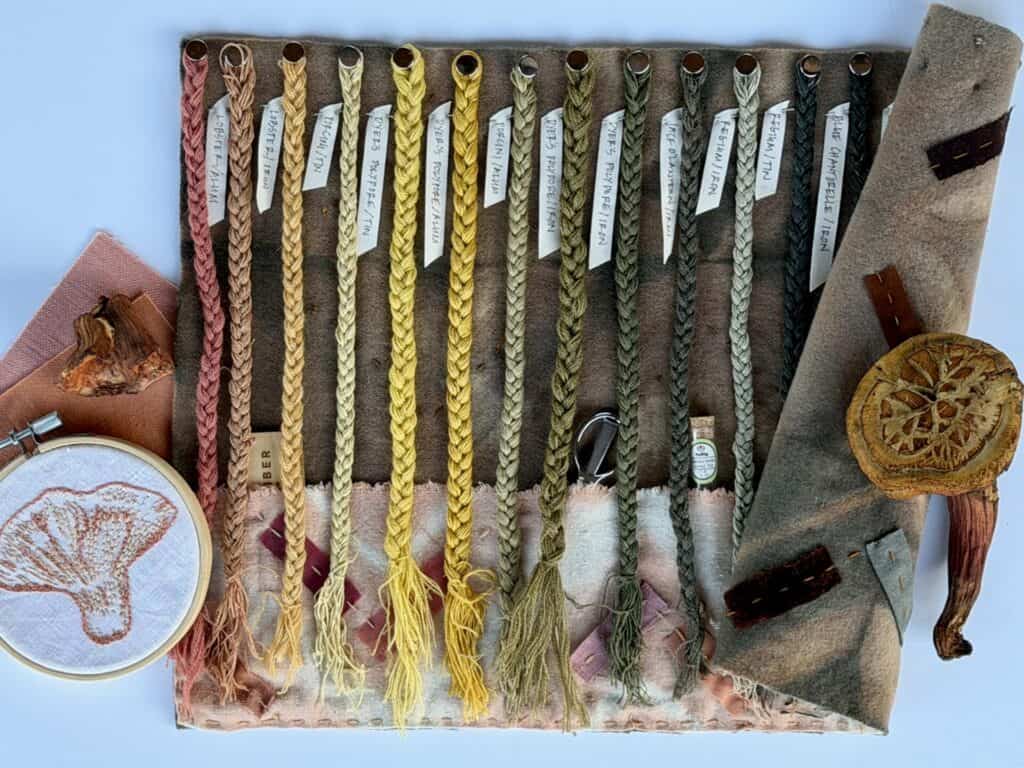
Finding any mushroom is a delight, but especially those that yield color. The tiny Surprise Webcaps always feel like a gift, the Blue Chanterelle can stop me in my tracks, and encountering a large Dyer’s Polypore often results in a happy dance.
At the same time, fungi are endlessly humbling. We are still learning so much about their chemistry and potential for color. I am particularly curious about fungal pigments, especially blues. Some mushrooms bruise a vivid blue, and I am deeply interested in whether that color can be captured and fixed as a stable pigment. It may not be possible, but the pursuit itself keeps me engaged. Fungi continually reminds me that this is not something to master, but something to remain in relationship with.
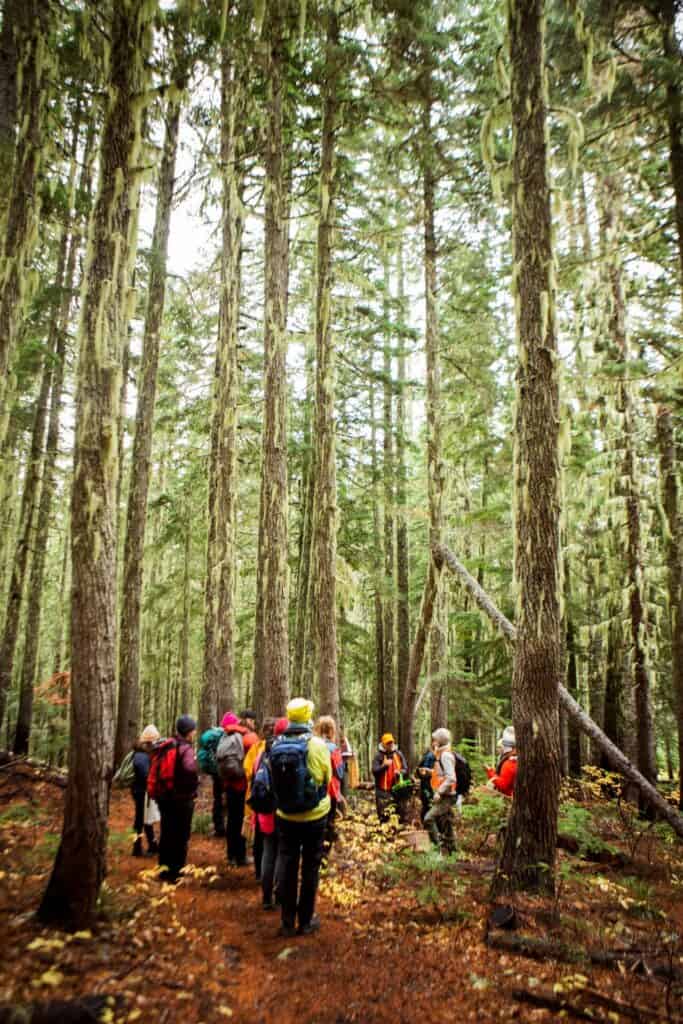
Natural dye practitioners often come from either the fiber arts side or the botany/foraging side. Where do you find the most interesting overlap — and where do you see the most room to learn from each other?
That intersection is at the heart of my practice. I came to this work through both fiber and mycology, each informing the other. Both require sensitivity to material and environment, and when they meet, something deeper opens.
In my textile practice, I bring an understanding of structure, technique, and how color lives in cloth. With my foraging, I bring knowledge of ecosystems, habitat, and timing. Together, they create work that is both grounded and expansive.
When you think about the community of people who dye with plants and fungi, what feels most alive and exciting in that world right now?
There is a growing spirit of curiosity and generosity in this community of exceptionally talented people. They are experimenting, sharing knowledge, and expanding what is possible. At the same time, there is a deepening awareness of ecology and responsibility. We recognize that this work is not just about color, but about our relationship with the natural world.
What will participants in your fall workshop with us actually do — what’s the hands-on experience you’re designing for them?
Over three days, we will explore the world of mushroom dyes from forest to finished piece. We will spend one day foraging, one day extracting and dyeing, and one day stitching, moving through the full process to create a traveling stitching kit. It is a tactile, immersive experience designed to provide a strong technical foundation in mushroom dyeing while offering an immersive, place-based experience of color.
Who is this workshop for? Is it beginners, experienced dyers, foragers? Or is there a sweet spot you’re hoping to reach?
The workshop is open to a range of experience levels. Beginners are welcome, as are experienced dyers curious about fungi. The common thread is a willingness to slow down and engage attentively with the material and environment. Participants should be comfortable spending up to five hours hiking in the forest, both on and off trail.
What’s one thing you want every participant to walk away knowing or feeling after spending a day with you?
A sense of surprise, curiosity, possibility, and a deeper appreciation for how color can emerge from fungi through observation, process, and connection with the natural world
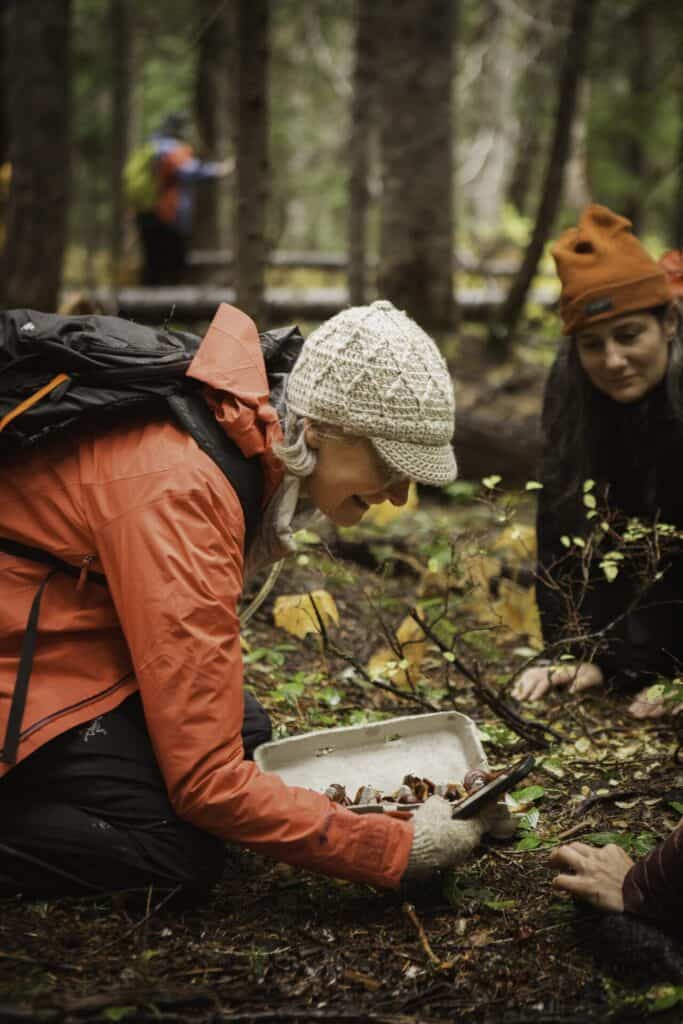
What’s on your workbench or in the field right now — what are you most curious about in your current practice?
I have more than two dozen mushrooms waiting to be tested and added to the Atlas, and I am slowly working through them alongside preparing for upcoming exhibitions and workshops.
I am also increasingly interested in how color can function as an ecological record. I am beginning to focus on site-specific work that maps fungal diversity within a landscape and translates it into color and form. It is a shift toward situating the work more fully within systems of place, time, and environment.
Where can people follow your work and start exploring before the workshop?
You can explore the Mushroom Color Atlas at mushroomcoloratlas.com or through the book. My broader studio practice is at juliebeeler.com and bloomanddye.com, and I share ongoing work and research on Instagram at @mushroomcoloratlas and @bloomanddye.
Any last notes?
This work is an invitation to look more closely. Fungi and color are not just things we see, but the result of complex, intelligent systems that emerge through relationships. The more attention we give them, the more they reveal.

