
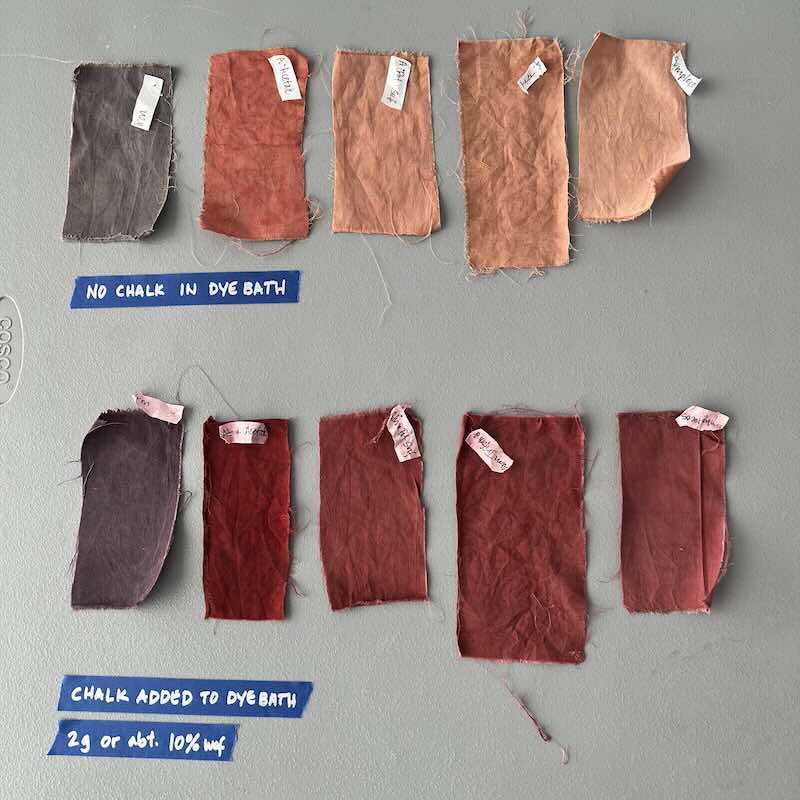
I just finished teaching A Nerd’s Guide to Mordants online this past weekend where we discussed the idea of adding minerals to the dye bath to develop deeper color. This is a technique that we’ve used in the PNW as our water is not very highly mineralized. Now many of the water sources in the United States are from groundwater sources that contain minerals like calcium and magnesium, and sometimes iron, so it’s easy to get rich reds from madder extract with little effort. However in Seattle, the water source is from snowpack and not from groundwater, so it’s somewhat demineralized. Madder extract reacts to calcium carbonate, also called chalk, to create redder shades, so we tried it and I was pleased at the results. Part of the reason that this is such a dramatic transformation is that Seattle tap water is slightly acidic and is also low in minerals like calcium. I took pH readings of a beaker of Seattle tap water, and another reading of a beaker mixed with 2 grams of calcium carbonate. Note that we use the term calcium carbonate and chalk interchangeably. Both refer to calcium carbonate.
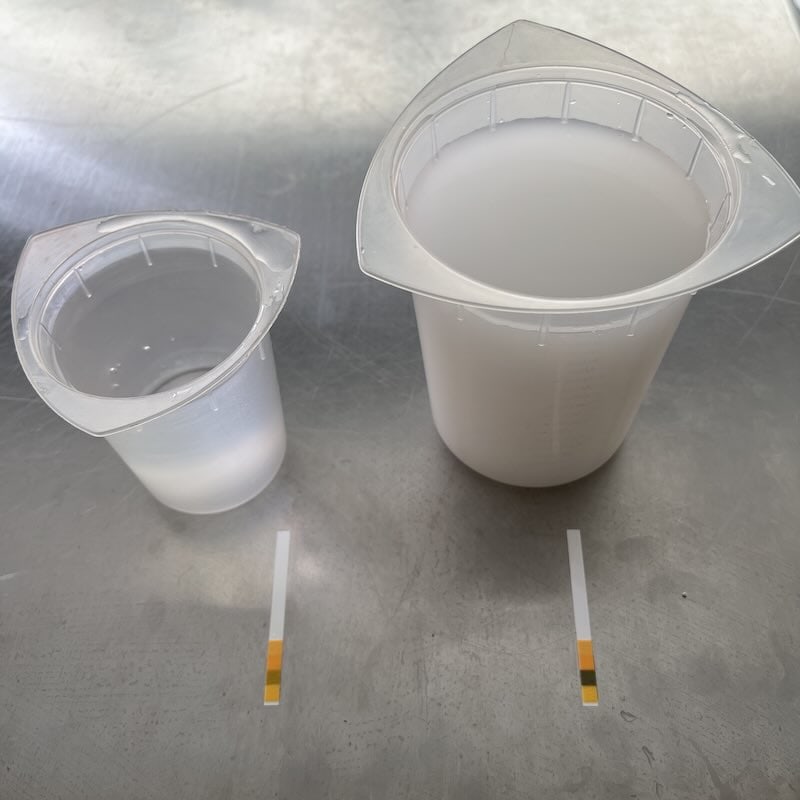
From the pH readings, the second box from the bottom is a light olive green on the left for Seattle tap water, and it is a darker green on the right with the Seattle water mixed with calcium carbonate.

Closer inspection shows that Seattle tap water is approximately pH 6, and our tap water mixed with calcium carbonate is about pH 7. Madder responds to both calcium and to a more neutral, and sometimes slightly alkaline pH level.
Our experiment
We mordanted cotton swatches in the following mordants: Iron, Aluminum Acetate. Aluminum Potassium Sulfate, Aluminum Triformate and Symplocos. All of the swatches were placed in a Mason jar as a dye bath and dyed with 8% madder extract. We did not add any calcium to the dye bath. After 45 minutes in the water bath and reaching a temperature of 140F, we removed the swatches. They were very light, with limited red development. The dye bath itself was also brown, rather than red. As I was discussing this interesting result, Sara, our TA suggested that we cut the samples in half and add half of each mordant variable back into the madder bath, and also add some calcium. Hmmm. This could get interesting.
We cut the swatches in half and set aside half of each swatch as the group that was dyed in a madder dye bath with no calcium.
We mixed 2 grams of calcium with a small amount of warm water and added it to the Mason jar dye bath full of madder liquid. The dye bath immediately began to turn deeper and more red. We added in the other half of the swatches and kept it at temperature (approx. 140F) for another 30 minutes or so. Then we let the dye bath cool a few minutes, removed the madder and chalk dyed swatches and rinsed them.
The results
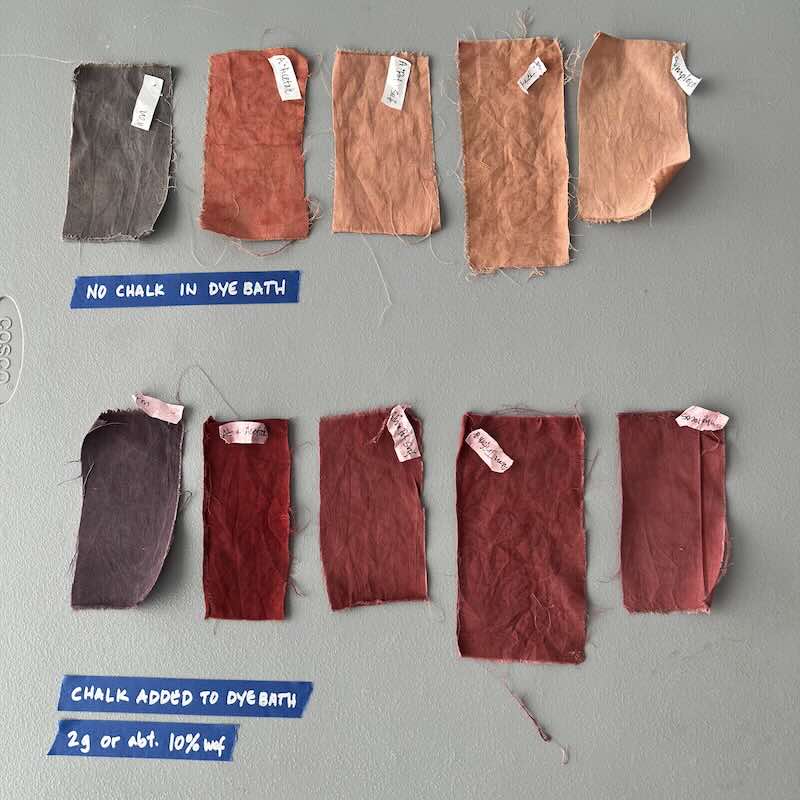
The left swatch is iron mordanted cotton. With no chalk in the bath, it’s a murky gray with a brown undertone. But with chalk added to the dye bath, the iron mordanted swatch turned purple.
The next swatch is Aluminum Acetate. This swatch had a chalk post bath in the mordant process and chalk in the dye bath. It is a light coral shade with no chalk in the dye bath, but a deep, rich red with chalk in the dye bath.
The third swatch from the left is mordanted with Aluminum Potassium Sulfate. The no chalk dye bath swatch is a light orange-brown and the chalk dye bath is a deeper brick red shade.
The fourth swatch from the left is mordanted with Aluminum Triformate. The no chalk dye bath is a slightly darker orange-brown and the chalk dye bath is a deeper, slightly redder brick shade.
The last swatch is mordanted with Symplocos. The no chalk dye bath sample is the lightest sample and is the brownest sample. The chalk dye bath sample is a brick red color.
Conclusions
For our Seattle water, calcium carbonate is a useful addition to bloom certain colors and we were able to achieve dramatic differences with a small addition of calcium carbonate. The next time you dye with madder, try adding a small amount of calcium carbonate to the dye bath. We’ve achieved results using as little as 1% wof, so a little goes a long way!
I’m wondering if Seattle water needs to be a higher pH? The samples show quite a difference. Does it works with most dyestuffs ? I want to use some collected materials, would it work better? All sorts of questions,sorry? Thanks, Esse
Our Seattle water is perfect for getting beautiful colors. However, if you notice that some of the foraged shades are fairly light or desaturated for the amount of dyestuff that you are using, it is interesting to check pH. Then you can decide if you will change it to see if more dye is released from the dyestuffs, or if the slightly higher pH encourages deeper color development. We don’t always modify pH, because many of the dyes will work in all sorts of types of water.