Mordant Monday: What is Dunging?

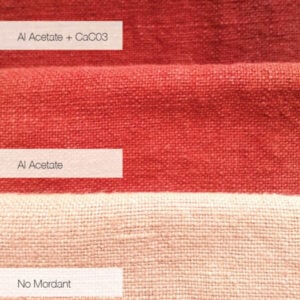
Cellulose fibers are the most common fiber that we start with as cotton fabric is readily available and affordable. However, cotton does not have the same affinity for natural dyes as protein fibers such as wool, so the cellulose mordant process is different to achieve good results. The mordant process for cellulose fibers includes pretreating with a tannin, then immersing the tannin treated fabric into an alum solution. This method is one of the earliest mordant methods for cellulose fibers and produces very good results. We use this method regularly as we also love to experiment with different tannins to … Read more
Mordant Monday: Spotlight on Sumac

Spotlight on Sumac Taking a little time to work more closely with tannins has been incredibly interesting! This week’s tannin exploration focuses on Sumac. Sumac is from the Rhus genus and its scientific name is Rhus coriaria. It’s native to southern Europe and western Asia where it is commonly known as Tanner’s Sumac or Sicilian Sumac. We are fortunate to have number of North American native sumac including Rhus glaubra, sometimes called Smooth Sumac, and Rhus typhina or Staghorn Sumac, known for its dramatic bright red berry clusters. The staghorn berries were used by indigenous people as a tea, and … Read more

Mordant Monday: A Rainbow Compilation!

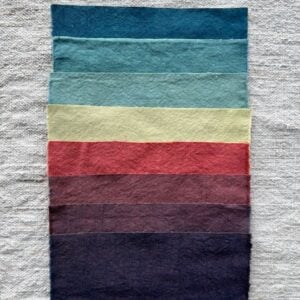
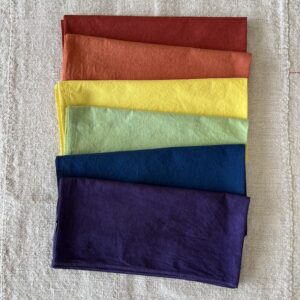
We wanted to compile all of our rainbow tutorials so you could have access to them all in the same place. We love creating them for you, and seeing the beautiful creations you make with your tutorials. Tannins provide a rich base for creating a rainbow of color. Please tag us on social media so we can see what you make! Try making the rainbow yourself!

Mordant Monday: Myrobalan Magic

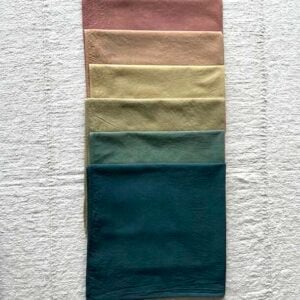
This week’s tannin exploration focuses on Myrobalan. I changed it up a bit this week by using our mordanted cotton bandana 6-pack as the base for exploring myrobalan. The convenience was a pleasant surprise and the colors came out beautiful. Myrobalan is a traditional cellulose tannin pre-treatment and dye, and used in Ayurvedic and traditional medicine. It’s an important color and used frequently in India and Southeast Asia. Myrobalan imparts a light yellow on cotton with a subtle light brown undertone, making it an ideal foundation for color overdyeing, and indigo combinations. Like our other examples, when combined with other … Read more

Mordant Monday: Dyes of The Américas

One of the first dyes that I ever encountered was cochineal, and although I was surprised that it came from an insect, I was also in love with its beautiful color.  Cochineal was the most important natural dye to originate from Oaxacan indigenous culture that still has great value and a global impact today. When Spanish colonizers realized the value of this dye, they created plantations and exploited indigenous labor to process up to 300,000 pounds of cochineal for export per year. It was one of the most precious colors and brought great wealth to the Spanish crown. Being in … Read more

Mordant Monday: Spotlight on Quebracho Moreno

For this Mordant Monday, we are diving into Quebracho Moreno. Quebracho (Schinopsis balansae and Schinopsis lorentzii) is an evergreen tree that grows wild in South America. It grows mainly in Argentina and Paraguay in dense sub-tropical forests which also include a variety of other trees and vegetation. The name is due to its hardness, and comes from two Spanish words, quebrar and hacha, meaning “axe breaker”. In fact, quebracho has been used locally for posts, telegraph poles, bridge timbers, railway ties, paving blocks and for any construction where great durability is desired. Quebracho Moreno (we used to carry a Quebracho Rojo, so we called this one Moreno) … Read more

Mordant Monday: In the clutches of Cutch Dye

Cutch Dye This week’s Mordant Monday explores another well known and important tannin: Cutch. Cutch is a wood dye from Senegalia catechu (formerly Acacia catechu), an acacia species that grows in South and Southeast Asia. The dye is both a colorant, and a traditional medicine. It is also the by-product from the manufacture of “katha”, which is a crystalline substance that is an ingredient in paan or betel nut leaf, which is an Indian mouth freshener and digestive. We’ve never tried paan, but we love cutch for its versatility and deep colors. It’s a sweet-smelling dye and the color yield … Read more

Mordant Monday: Planting a Dye Garden

“the sunflowers themselves far more wonderful than any words about them.”― Mary Oliver, Upstream: Selected Essays Spring is coming so now is the chance to grow a few pots of your own color: dye flowers or indigo, or perhaps plant out some madder root for future harvest. Growing dye plants from seed is very rewarding, and you may have enough starts to share with your friends and community. There is a magic to walking outside and checking to see how the dye plants are doing. A few minutes inspecting, watering and talking to them is immensely calming. Watching the pollinators feast reminds … Read more

How to Mordant with Aluminum Potassium Sulfate

Our How To guides are intended to make the mordant process easy, from scouring your fibers to dyeing with an assortment of dyes. You can find other How To guides here. What is Mordanting? Mordanting is the most important process of preparing fibers to accept color. Using a mordant helps to ensure the most durable and long-lasting colors. With the exception of indigo (as a vat dye, it does not require a mordant), this is not an optional step. Mordanting provides the dyer flexibility as fibers can be mordanted in advance, dried, and dyed later, or mordanted and dyed in … Read more

wheat bran mordant assist

MORDANT MONDAY: Fixatives & Funky Water

We get mordant questions all the time at Botanical Colors so why not create Mordant Monday??? Got mordanting questions? Email [email protected] YOU ASKED: I used your cold water Aluminum Triformate mordant. I dissolved it in cold water and poured it into the cold water tub. It was really cloudy when I added the fabric. Now the mordant has settled on the bottom of the pot. Is that right? If not, is there a way to rectify it. KATHY ANSWERED: If there are a few grains of mordant at the bottom, it’s not a problem.  If there’s a layer of mordant, … Read more