MORDANT MONDAY: Aluminum Sulfate For Cellulose?

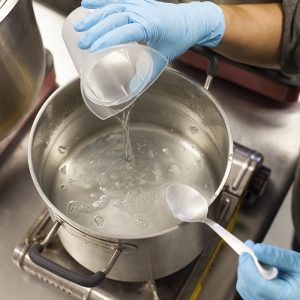
We get mordant questions all the time at Botanical Colors so why not create Mordant Monday??? Got mordanting questions? Email [email protected] YOU ASKED: I realized I purchased aluminum sulfate instead of potassium aluminum sulfate. I am mostly looking to dye cellulose fabric yardage. Will aluminum sulfate work as a mordant for cellulose fibers? KATHY ANSWERED: Yes, it will work: aluminum sulfate and aluminum potassium sulfate are largely interchangeable. It used to be that aluminum sulfate could contain traces of iron, which would shift colors, but most modern day aluminum sulfate is pretty “clean” – at least I haven’t had an … Read more

MORDANT MONDAY: Silk, Cashmere + Heat

We get mordant questions all the time at Botanical Colors so why not create Mordant Monday??? Got mordanting questions? Email [email protected] YOU ASKED: I have several cashmere sweaters that are the most boring colors ever and I’d love to try over-dyeing. I have Orvis paste to scour with but wanted to check that the 180 degree hold for 30 minutes would also work for cashmere – I see sheep and goats on the website answer about scouring so I am assuming yes, but there is this little question in the back of my head – email to the experts it … Read more

MORDANT MONDAY: Let’s Talk Aluminum

We get mordant questions all the time at Botanical Colors so why not create Mordant Monday??? Got mordanting questions? Email [email protected] YOU ASKED: I used acorn extract as a tannin treatment on cotton, rinsed it like crazy, and put it in my aluminum triformate bath. Now the aluminum triformate bath has changed color. Should I toss it? I was hoping it would last awhile more and I could put it to use. KATHY ANSWERED: If you are using the bucket method for aluminum triformate mordanting, I would keep the bath. It’s probably still just fine and there’s a lot of … Read more

A Humble, Ingenious Leaf Mordant: Symplocos

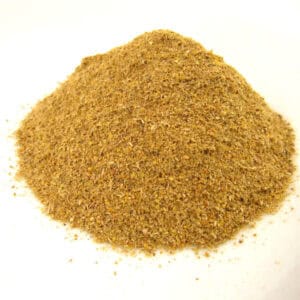
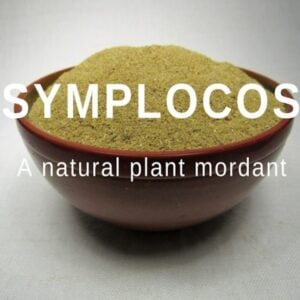
The plant world contains species that draw alum from the soil and store them in their tissue – they’re referred to as alum accumulators or hyper accumulators. There’s a plant species called symplocos that is an alum accumulator and contains enough alum to be used as a plant-based mordant. We carry symplocos and are happy to have a new shipment arriving this week, so it’s a good time to review this mordant alternative with a great backstory. The Story of Symplocos In 2005 and 2006, The Bebali Foundation (a partner enterprise to Threads of Life that focuses on sustainable economic … Read more

Mordant Monday: Tannin Workshop Review

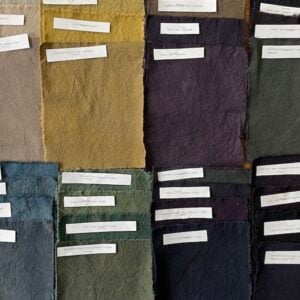
Mordanted fat quarters in iron, marigold, indigo, marigold+indigo, logwood, logwood+ indigo, logwood + marigold and logwood + marigold+ indigo. Both Cara and I taught new online workshops about tannins and natural dyes this month. Cara introduced Tannin Grayscale, a fascinating look into using iron and tannin to create a rich range of deep and moody neutrals. I had envisioned that this would be a workshop on gray, gray and more gray, but the surprise was that her techniques create some beautifully saturated shades. My workshop was Tannin Rainbow, where I concentrated on combining different tannin mordanted fabrics with natural dye … Read more

Mordant Monday: Creating Color In Tucson

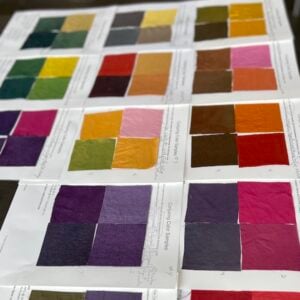
We used raw dyestuffs: cochineal insects, coreopsis flowers, marigolds, extracts and two indigo vats (henna and fructose). I was very impressed how beautiful the colors came out! I was fortunate to teach in Tucson, Arizona last month for the Tucson Handweavers and Spinners Guild. This was my first time in Arizona and it was a wonderful experience.  The dramatic desert landscape really commands your attention and the light just before sunset is luminous. The swatches are from a number of different dye baths and we mixed and matched colors to create 4-color palettes with an indigo dip at the end. … Read more

Mordant Monday: Chalk and Madder Experiment

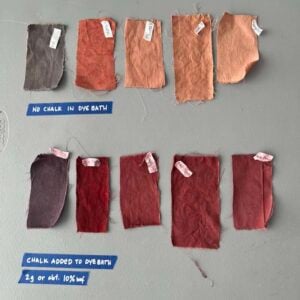
I just finished teaching A Nerd’s Guide to Mordants online this past weekend where we discussed the idea of adding minerals to the dye bath to develop deeper color. This is a technique that we’ve used in the PNW as our water is not very highly mineralized. Now many of the water sources in the United States are from groundwater sources that contain minerals like calcium and magnesium, and sometimes iron, so it’s easy to get rich reds from madder extract with little effort. However in Seattle, the water source is from snowpack and not from groundwater, so it’s somewhat … Read more