MORDANT MONDAY: Mixing Mordants

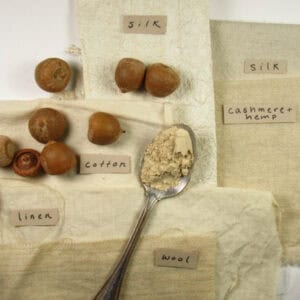
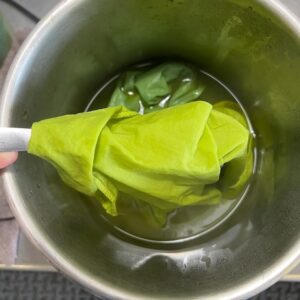
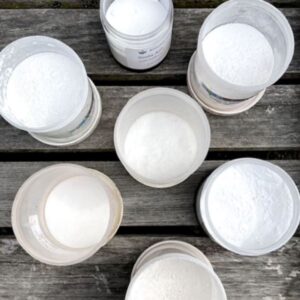
We get mordant questions all the time at Botanical Colors so why not create Mordant Monday??? YOU ASKED: I’m just trying out your new cold mordant aluminum triformate and have mordanted wool, bamboo and cotton After applying tannin to the cellulose I dropped it into the aluminum triformate together with the wool, and the water changed to green. I guess it’s due to the connection between tannin and aluminum? But am I doing something wrong and are the textiles fine for dyeing now? I want to save the mordant bath for further use but now it has a suspicious color. … Read more

Sunday Visit: Foraging the Forest with Julie Beeler

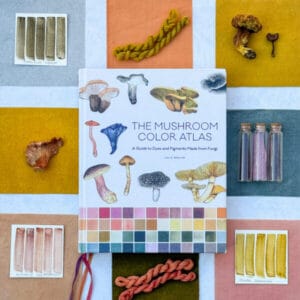
For Sunday Visit, Botanical Colors sits down with Julie Beeler, the artist and researcher behind Mushroom Color Atlas, to talk about her fall workshop and the surprising, luminous world of fungi-based color. From her base in the Pacific Northwest, Julie has spent years building a living reference of mushroom dyes — cataloging the reds, golds, rusts, greens, blues, and grays that emerge when fiber meets fungus — inviting dyers to look past the forest floor and into an entirely different color story. For those just discovering your work, how would you describe what the Mushroom Color Atlas is — and … Read more

Mordant Monday: Spotlight on Quebracho Moreno

For this Mordant Monday, we are diving into Quebracho Moreno. Quebracho (Schinopsis balansae and Schinopsis lorentzii) is an evergreen tree that grows wild in South America. It grows mainly in Argentina and Paraguay in dense sub-tropical forests which also include a variety of other trees and vegetation. The name is due to its hardness, and comes from two Spanish words, quebrar and hacha, meaning “axe breaker”. In fact, quebracho has been used locally for posts, telegraph poles, bridge timbers, railway ties, paving blocks and for any construction where great durability is desired. Quebracho Moreno (we used to carry a Quebracho Rojo, so we called this one Moreno) … Read more

Mordant Monday: In the clutches of Cutch Dye

Cutch Dye This week’s Mordant Monday explores another well known and important tannin: Cutch. Cutch is a wood dye from Senegalia catechu (formerly Acacia catechu), an acacia species that grows in South and Southeast Asia. The dye is both a colorant, and a traditional medicine. It is also the by-product from the manufacture of “katha”, which is a crystalline substance that is an ingredient in paan or betel nut leaf, which is an Indian mouth freshener and digestive. We’ve never tried paan, but we love cutch for its versatility and deep colors. It’s a sweet-smelling dye and the color yield … Read more

Mordant Monday: Tannin Rainbow with Chestnut, Fustic, Iron and Indigo

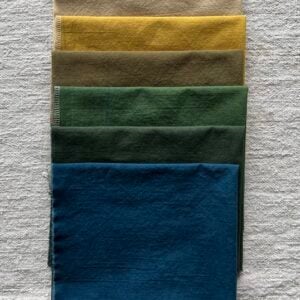
Tannin Rainbow with Chestnut, Fustic, Iron and Indigo This week’s Mordant Monday focuses on Chestnut. We used Chestnut extract in our gradation and absolutely loved the combination of Chestnut, Fustic and Iron with Indigo. This gradation is slightly different than our previous experiments. This time I did not overdye with a warm shade like Madder, to get corals and pinks. I wanted to focus on green and blue. Like previous examples, when a tannin is combined with other colors you can get exciting mixes and beautiful color blends that harmonize and are perfect for patchwork, creating gradations and stitching. If … Read more

Sunday Visit: The Eco-Printed Image with Sydni Gause

For Sunday Visit, Botanical Colors sits down with Sydni Gause, the natural dyer and fiber artist behind Sydni Gause Silks, to talk about her Eco-Printed Image workshop and the plant stories held inside silk. From her studio in Panama City, Florida, Sydni has developed a pictorial eco printing method that blurs the line between printmaking, painting, and collage, inviting participants to see plant material as more than a single leaf or flower. You developed something you call “The Eco-Printed Image,” a pictorial approach to eco printing. How did this way of working with plants and silk emerge for you over … Read more

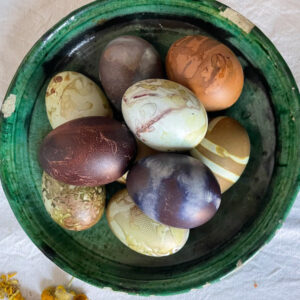
multicolored dyed eggs in a green ceramic bowl

Dye Easter Eggs With Natural Dyes

Everyone from kids to adults love to get their hands messy when they dye Easter eggs with natural dyes. This is a fun tutorial for adults and kiddos (parents help, please) to make a little Easter magic. First things first, let’s talk about health & safety: We always recommend working in a very well ventilated area. Although natural dyes are non-toxic, when using fine powders it’s best to wear a mask, and keep the windows open. Be mindful around little ones and pets as you don’t want anything going in mouths that shouldn’t be there. Also, when beginning to set … Read more

Mordant Monday: LIME GREEN

On this Saint Patrick’s Day, learn how to make this punchy lime green! We are pulling this exciting color back from our archives. Wink wink, you might remember it from this summer…Using weld and indigo, you can get awfully close to this punchy acid green. Natural dyes are often thought of as pastel or “soft” colors, but we’re here to help you make a hue that really packs a punch! This is the basic recipe Start with a mordanted cotton bandana, soak it in warm water for 30 minutes to thoroughly wet it out, and dip in a very light … Read more

Sunday Visit: Women’s Day, Celebrating Kenya Miles of Blue Light Junction

On this International Women’s Day, we’re honoring the visionary, natural dyer and community organizer that is Kenya Miles—artist, urban farmer, and founder of Blue Light Junction, Baltimore’s first natural dye studio and a living monument to love in action. As Kenya and her team enter a new chapter of tending vats, garden beds, and community, they’re asking for our tangible support to keep this sanctuary of global dye traditions, education, and mutual care thriving. If Blue Light Junction’s work resonates with you, please take a moment today to visit their GoFundMe and give what you can, share if you’re able, … Read more

Mordant Monday: Planting a Dye Garden

“the sunflowers themselves far more wonderful than any words about them.”― Mary Oliver, Upstream: Selected Essays Spring is coming so now is the chance to grow a few pots of your own color: dye flowers or indigo, or perhaps plant out some madder root for future harvest. Growing dye plants from seed is very rewarding, and you may have enough starts to share with your friends and community. There is a magic to walking outside and checking to see how the dye plants are doing. A few minutes inspecting, watering and talking to them is immensely calming. Watching the pollinators feast reminds … Read more